
Strategic Planning for NGOs: Making Difficult Choices, Not Just Writing a Strategic Plan

IREGS World | Strategy Development & Strategic Planning
The strategic plan that changes nothing
An NGO does not necessarily have an effective strategy simply because its board has approved a strategic plan.
A comprehensive planning process can involve extensive consultations, country office workshops, external facilitation, environmental analysis and the formulation of ambitious strategic objectives. The resulting document may be coherent, professionally presented and widely endorsed.
Yet its adoption does not guarantee that programme selection, recruitment, fundraising or resource allocation will be managed differently. Country offices may continue pursuing available funding opportunities, departments defending their existing portfolios, and senior management addressing operational pressures without systematically referring to the strategy.
This distinction between adopting a strategic plan and practising strategic management deserves greater attention.
At IREGS World, we propose that the value of strategic planning should ultimately be judged by the quality of the organisational decisions it enables, rather than simply by the quality of the document it produces.
A strategic plan is not a strategy
The distinction between strategic planning and strategic thinking is not new. In his influential article The Fall and Rise of Strategic Planning, Henry Mintzberg distinguished the analytical nature of formal planning from the judgement and synthesis required to develop strategy.
Richard Rumelt, in Good Strategy/Bad Strategy, identifies three essential components of effective strategy: a diagnosis, a guiding policy and coherent action.
This distinction is particularly relevant to NGOs. Their missions are often deliberately broad, encompassing ambitions such as reducing poverty, advancing human rights, strengthening resilience or promoting social justice.
Such ambitions provide institutional purpose, but they do not necessarily provide strategic direction.
An organisation committed to reducing poverty could legitimately pursue dozens of different interventions. Its strategy must determine which barriers it is best positioned to address, where it can make a distinctive contribution and how it will concentrate its limited resources.
This does not mean formal strategic planning is ineffective. A 2019 meta-analysis, covering 31 empirical studies, found a positive association between strategic planning and organisational performance. A 2024 study of 1,256 US nonprofits similarly found an association between having a strategic plan and higher organisational capacity.
Although these findings do not establish causation, they challenge the assumption that formal planning is inherently bureaucratic or unproductive.
The issue is not whether organisations should plan. It is whether their planning processes generate meaningful strategic choices.
Participation does not necessarily create ownership
Participatory strategic planning has become an important feature of NGO organisational practice. Its rationale is sound: individuals who contribute to developing a strategy may be better positioned to understand, support and implement it.
Research on employee commitment to strategic change provides some support for the importance of participative communication. Nevertheless, participation and ownership should not be treated as interchangeable.
Consider a decentralised international NGO. Headquarters may prioritise organisational coherence, global positioning and donor accountability. Country offices may be more concerned with national political realities, programme continuity, local partnerships and immediate funding pressures.
Neither perspective is inherently wrong. Both reflect legitimate institutional responsibilities. The challenge is determining how these different perspectives influence strategic choices.
Research on centralisation in international NGOs illustrates the complexity of this relationship, suggesting that centralisation can generate internal coordination benefits while also presenting external reputational challenges.
IREGS proposes an Ownership Ladder to help organisations distinguish between different dimensions of involvement:
Heard → Consulted → Participated → Influenced → Accountable → Uses the strategy in decisions.
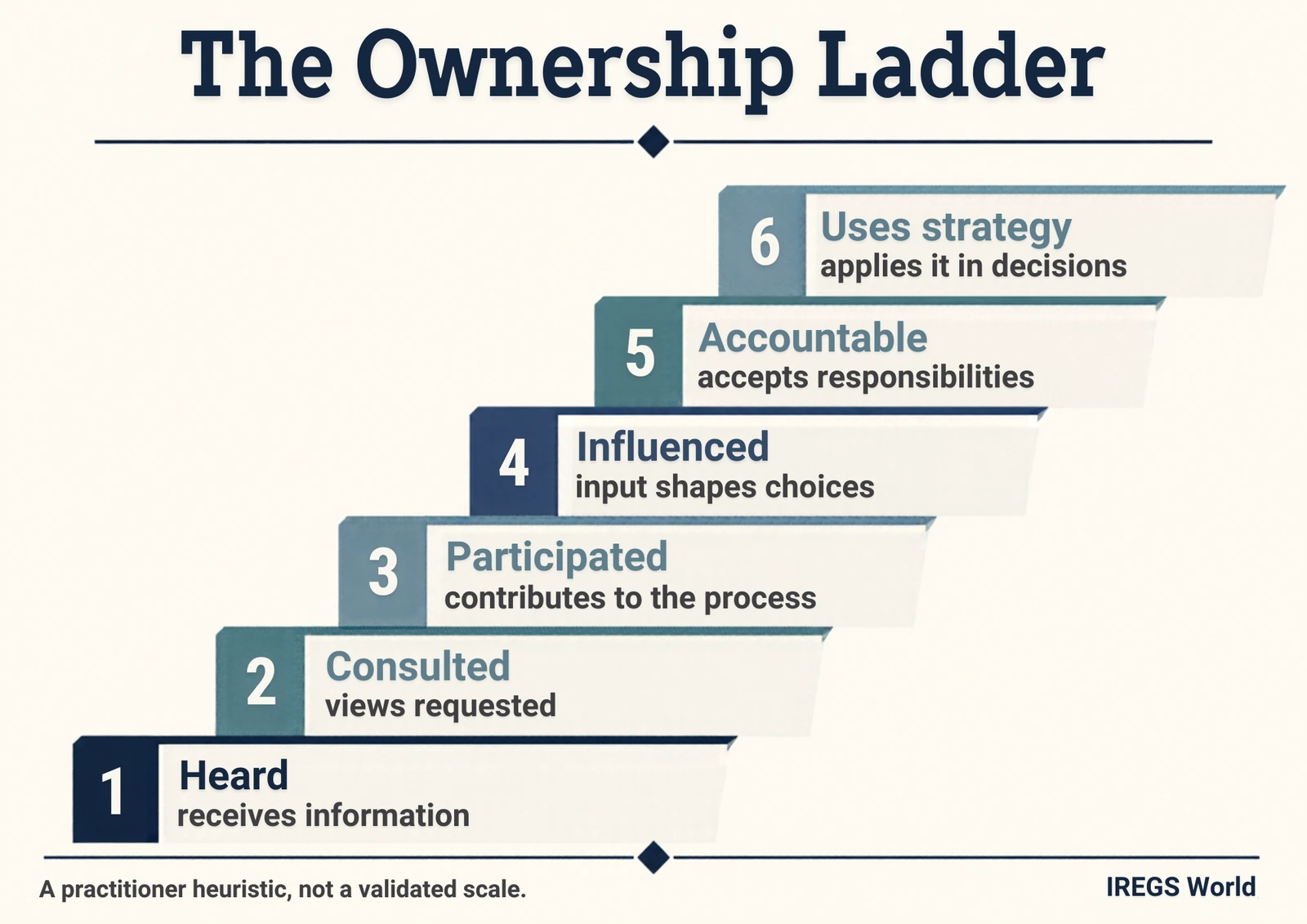
The distinction is important. Attending a workshop does not demonstrate influence. Contributing to a strategy does not necessarily imply decision-making authority. Accepting an implementation responsibility does not automatically mean someone will use the strategy when confronted with competing priorities.
ActionAid International's proposed 2025–2028 Strategy Implementation Framework provides an example of an extensive participation process involving colleagues from 35 countries, successive feedback rounds and governance review.
The lesson is not that every participant must have equal decision-making authority. Rather, participation should be designed so that people understand where they can influence decisions, who ultimately makes those decisions and how their contributions have been considered.
Strategy means deciding what not to do
One of the most demanding aspects of NGO strategic planning is reconciling legitimate needs with finite institutional resources.
Few development or humanitarian challenges can be dismissed as unimportant. Yet attempting to address every legitimate need risks dispersing organisational capacity, weakening programme quality and undermining financial sustainability.
Strategic planning can compound this problem when consultation becomes an exercise in accumulating priorities. Each department, country office or stakeholder group seeks recognition of its concerns, while leadership may find it difficult to exclude otherwise worthwhile proposals.
Broad strategic language can sometimes serve a legitimate purpose. Qualitative research on an international development NGO found that ambitious and ambiguous strategies could help managers build consensus and legitimacy during organisational change.
Eventually, however, decisions about money, people and institutional commitments must be made.
One international human rights movement illustrates how strategic priorities can be translated into explicit resource choices. Its 2022–2030 strategic framework establishes an allocation principle directing 80% of human rights resources towards two global priorities, with up to 20% available for more flexible, context-specific work. Exceptions require explanation.
The significance of this example lies not in the particular percentages, but in the explicit connection between priorities and resources.
To support such decisions, organisations could maintain a Choice Ledger recording the problem being addressed, the selected approach, alternatives rejected, resources committed, decision authority and conditions for reconsideration.
A strategy that identifies what an organisation will do, without confronting what it will not do, remains incomplete.
Connecting strategy to operational reality
A strategic choice becomes institutionally meaningful when it influences how an organisation operates.
Consider an illustrative NGO whose geographical expansion has stretched management capacity, weakened programme oversight and increased dependence on short-term project funding.
Its strategic response might be to prioritise institutional consolidation and programme depth over further expansion.
Such a choice would have several operational implications. Resources would be concentrated in existing priority countries. National programme leadership and quality assurance would receive greater attention. Funding opportunities requiring unsupported geographical expansion would be declined. Country offices would retain flexibility to respond to local needs within agreed strategic boundaries.
The organisation would also establish conditions under which expansion could be reconsidered, including improvements in management capacity, programme quality and financial sustainability.
These decisions transform an abstract ambition into a coherent institutional response.
This is where financial management becomes inseparable from strategic management. A strategy should be traceable into annual budgets, staffing plans, fundraising decisions and management priorities.
IREGS proposes a Strategy–Resource Traceability Review through which leadership periodically examines whether actual expenditure, staffing capacity, fundraising pipelines and management attention reflect agreed strategic priorities.
Importantly, resource allocation cannot always be changed immediately. Existing donor commitments, restricted funding, contractual obligations and operational dependencies may limit management's options.
The strategic responsibility is to recognise these constraints, manage the transition and avoid making commitments that further undermine the organisation's chosen direction.
Designing a strategic planning process that works
Effective NGO strategic planning does not require abandoning established tools such as SWOT analysis, PESTLE analysis, stakeholder consultations or theories of change.
These tools can provide useful structure. Problems arise when completing them becomes a substitute for strategic judgement.
The starting point for designing a planning process should therefore be the decisions the organisation needs to make.
A rapidly growing national NGO may need to determine how to strengthen governance and management capacity. An international federation may need to reconcile global coherence with country-level autonomy. An organisation facing declining donor funding may need to reconsider its programme portfolio and financial model.
These are fundamentally different strategic challenges. They should not automatically be addressed through identical planning processes.
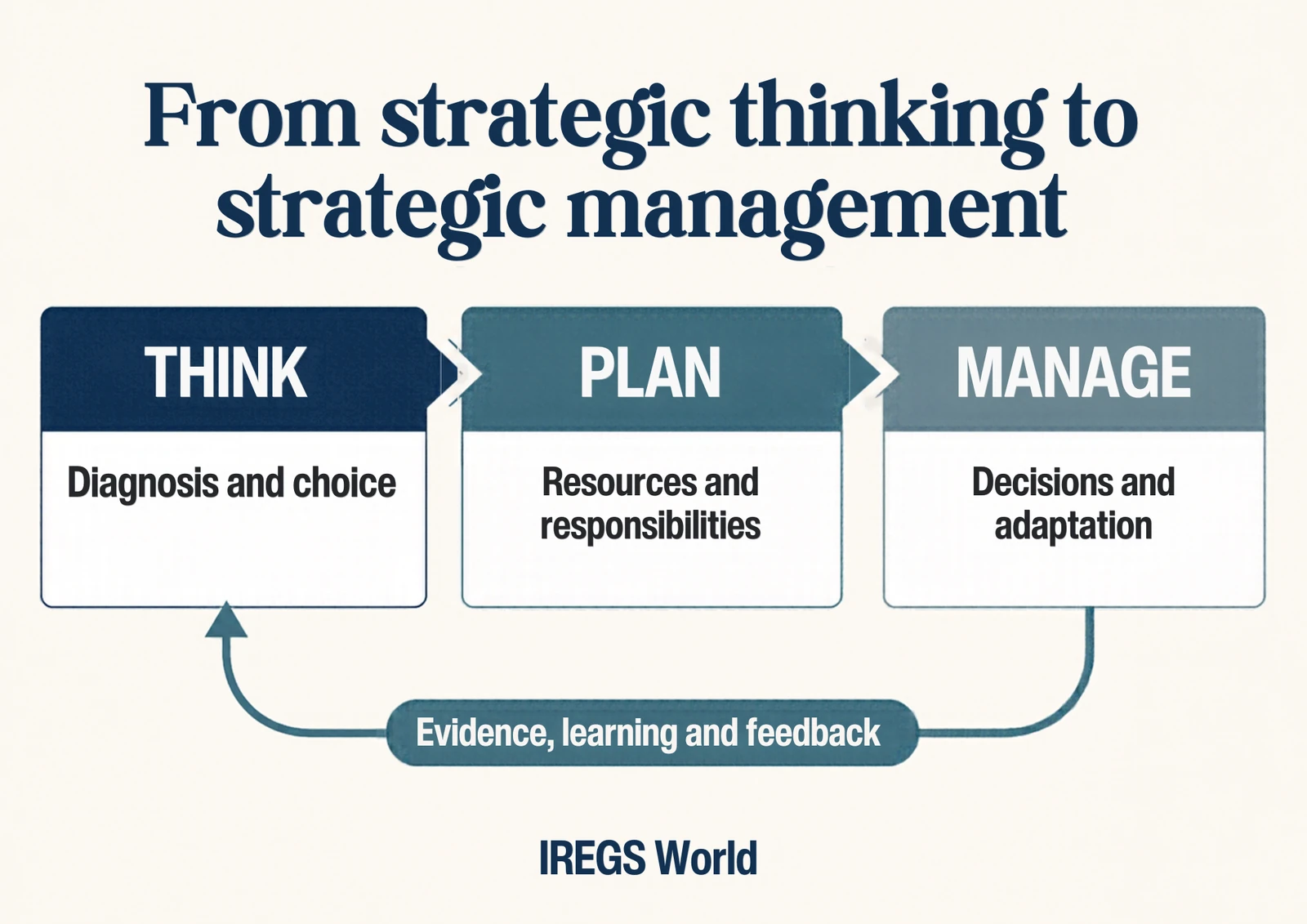
Building on John Bryson's conception of nonprofit strategic planning as an iterative process of thinking, action and learning, we propose six adaptable design principles:
- Establish the strategic mandate and clarify decision-making authority.
- Develop a diagnosis grounded in evidence and institutional realities.
- Generate and critically examine alternative strategic options.
- Make explicit choices and communicate their implications.
- Translate those choices into operational commitments.
- Establish mechanisms for learning, review and adaptation.
The 2024–2027 strategy of Twaweza East Africa offers a useful illustration of connecting strategic hypotheses with evaluation, resource planning and organisational learning.
This approach recognises that a strategy represents a considered judgement about how change can be achieved. That judgement must remain open to challenge.
Changing a strategy in response to new evidence or circumstances is not necessarily a failure of implementation. It may demonstrate effective strategic management. The distinction lies in whether the change is deliberate, justified and appropriately authorised.
The IREGS Strategy Use Test
How can NGO leaders determine whether their strategy is serving a meaningful management function?
A useful starting point is to examine the decisions their organisation has made since adopting its strategy.
The distinction between approving and using a strategy is illustrated by BoardSource's 2015 survey of US nonprofits. While 89% of responding organisations reported having a strategic plan, only 20% of chief executives awarded their boards the highest performance grade for adopting and following it.
Although the survey is historical and not globally representative, it raises an important question about strategic follow-through.
Is your organisation using its strategy or simply maintaining a strategic plan?
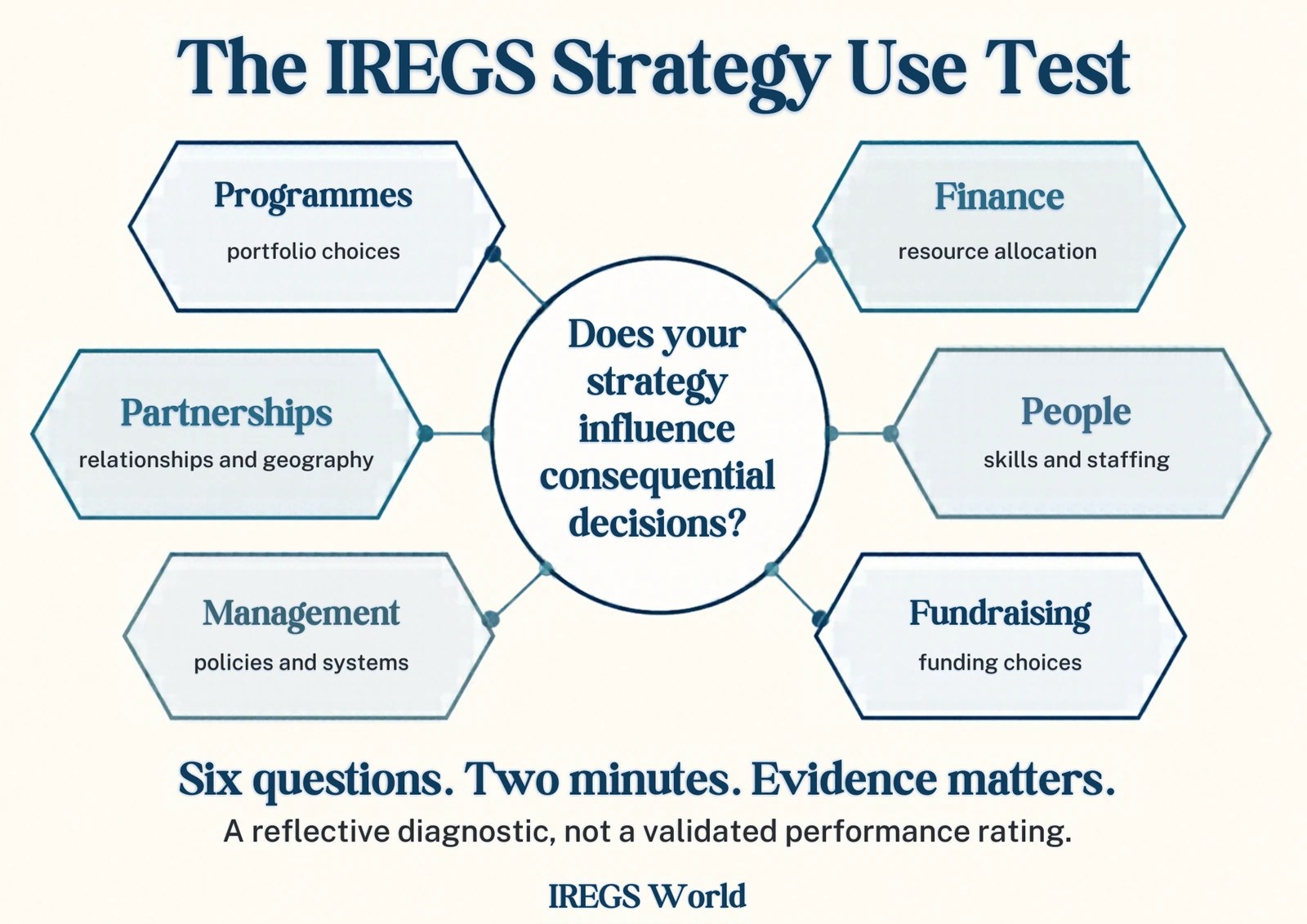
Take the two-minute IREGS Strategy Use Test. Reflect on decisions made during the past twelve months, or since adopting your current strategy if more recent.
For each question, consider whether you can identify a concrete decision influenced by your strategy.
Evidence could include board minutes, budget reallocations, recruitment decisions, programme portfolio reviews, documented funding decisions or revised partnership arrangements.
A decision to maintain an existing course can also demonstrate strategic use, provided management has consciously tested that course against its strategic priorities.
The most revealing question may therefore be:
What consequential decision would we have made differently if our organisation did not have its current strategy?
If leadership struggles to identify such a decision, there may be a disconnect between strategic planning and strategic management that warrants attention.
Strategy is a leadership responsibility
Consultants can help organisations analyse their operating environments, challenge assumptions, facilitate difficult conversations and develop effective strategic management arrangements.
They cannot substitute for institutional leadership.
Boards and senior management must ultimately determine which choices the organisation will make, which trade-offs it will accept and how it will remain accountable for implementation. Country directors and programme leaders must understand where they have discretion and how their decisions contribute to the wider strategy.
The strategic plan is an important instrument for communicating and coordinating these commitments. But its approval should mark the beginning of sustained strategic management, not the end of a planning exercise.
The real achievement is not producing a strategy that everyone can endorse.
It is developing a strategy that the organisation has the courage, capacity and discipline to use.